



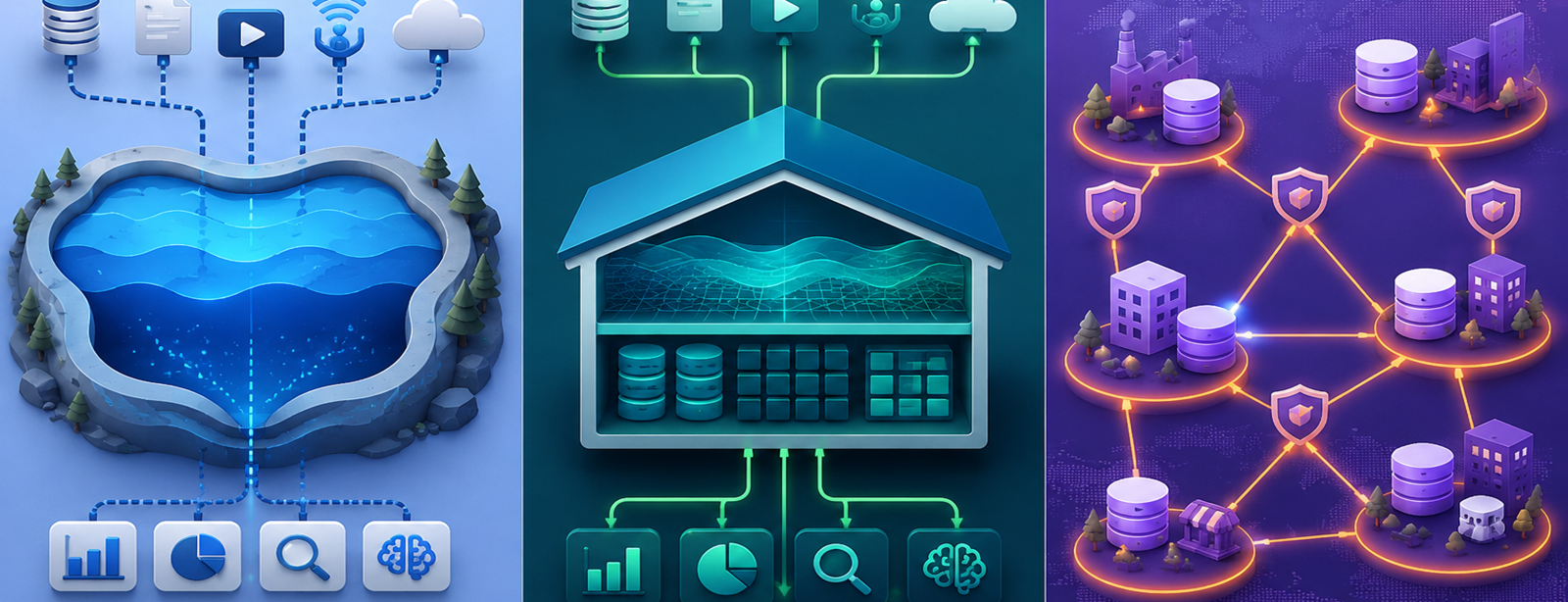

Data Lake, Data Lakehouse, and Data Mesh describe different parts of a data environment. A Data Lake focuses on storing data at scale. A Data Lakehouse adds management and analytical capabilities to lake-based storage. Data Mesh defines how data ownership, platform services, and governance can be distributed across business domains.
Treating these approaches as direct substitutes can lead to weak architecture decisions. The appropriate choice depends on whether the main requirement involves flexible storage, reliable analytics, or organizational scale.
What Each Architecture Means
Data Lake
A Data Lake is a repository for large volumes of structured, semistructured, and unstructured data, often retained in its original or minimally processed form. Most Data Lakes use distributed file systems or object storage and apply structure when data is processed or queried. This approach is commonly called schema-on-read.
- Storage layer: Object storage or distributed file systems, such as Amazon S3, Azure Data Lake Storage, or Hadoop Distributed File System.
- Data state: Raw, staged, and curated data can coexist in separate zones.
- Primary users: Data engineers, data scientists, and machine learning engineers who need access to detailed source data.
- Primary value: Cost-effective retention of high-volume and varied data.
- Main limitation: Without cataloging, lineage, quality controls, and defined ownership, data can become difficult to discover and trust.
Data Lakehouse
A Data Lakehouse is an architectural pattern that brings data warehouse capabilities to lake-based storage. It uses table metadata and transaction layers to support reliable updates, schema controls, versioned data, and SQL analytics while preserving access to open data files. The 2021 Lakehouse paper describes this pattern as a way to unify data warehousing and advanced analytics on open formats.
- Storage layer: Object storage managed through table formats such as Apache Iceberg, Delta Lake, or Apache Hudi.
- Data management: Transaction support, schema evolution, metadata, version history, and controlled updates.
- Primary users: Business intelligence teams, analysts, data scientists, and machine learning engineers.
- Primary value: One governed data foundation can support SQL analytics and advanced analytics workloads.
- Main limitation: A Lakehouse improves the technology layer, but it does not resolve unclear ownership, weak governance, or poor data-product practices by itself.
Data Mesh
Data Mesh is a decentralized approach to analytical data management. It places responsibility for data products with the business domains that understand and produce the data, supported by a self-service platform and federated computational governance. Zhamak Dehghani introduced the concept in 2019 in response to scaling limits in centralized data platforms.
- Ownership model: Cross-functional domain teams own defined data products and their quality, documentation, and service expectations.
- Platform model: A shared self-service platform provides reusable capabilities for building, publishing, securing, and observing data products.
- Governance model: Organization-wide standards are defined collectively and enforced through automated controls where practical.
- Technology model: Data Mesh can operate on a Data Lake, a Data Lakehouse, a data warehouse, or a combination of platforms.
- Main limitation: Adoption requires changes in accountability, incentives, skills, and ways of working. Thoughtworks’ 2026 review identifies organizational change as a greater obstacle than technology change.
Architectural Comparison
| Feature | Data Lake | Data Lakehouse | Data Mesh |
|---|---|---|---|
| Primary focus | Scalable storage | Reliable analytics on lake storage | Distributed ownership and governance |
| Approach type | Storage architecture | Data platform architecture | Organizational and architectural approach |
| Ownership | Usually centralized | Usually centralized or platform-led | Distributed across business domains |
| Data and formats | Native or minimally processed files | Managed tables on open file formats | Varies by domain and platform |
| Schema and reliability | Primarily schema-on-read | Schema enforcement, evolution, transactions, and versioning | Defined through product contracts and shared standards |
| Governance | Requires added catalog, quality, access, and lineage controls | Centralized platform controls are common | Federated policies with shared and automated enforcement |
| Best fit | High-volume retention and exploratory use | Business intelligence, analytics, and machine learning on shared data | Large organizations with many data-producing domains |
| Main risk | Poor discoverability and trust | Platform complexity without clear operating ownership | Decentralization without domain readiness or common standards |
When a Data Lake Is Appropriate
A Data Lake is appropriate when the primary requirement is flexible, cost-effective storage and the organization has the controls needed to manage it.
- The organization needs to retain large volumes of raw or varied data for future use.
- Data arrives from many sources before final analytical models are defined.
- Data science and machine learning teams need detailed source data for exploration and feature development.
- Cataloging, access control, lineage, and quality processes are available or planned.
A Data Lake is less suitable as the main consumption layer when most users depend on stable SQL models, governed metrics, and predictable reporting performance.
When a Data Lakehouse Is Appropriate
A Data Lakehouse is appropriate when the same data foundation must support governed reporting and advanced analytics.
- Business intelligence, data science, and machine learning teams need to work from a shared data foundation.
- The current architecture creates duplicate copies or synchronization work between a Data Lake and a separate warehouse.
- Workloads require transaction support, schema evolution, version history, and reproducible queries.
- The organization wants open access to data files across more than one processing engine.
A Lakehouse can be unnecessarily complex for a small reporting environment that is already served reliably by a conventional data warehouse.
When Data Mesh Is Appropriate
Data Mesh is appropriate when centralized ownership has become an organizational bottleneck and several domains are ready to take responsibility for data products.
- Many business domains produce and consume data, and a central team cannot meet demand at the required pace.
- Domain teams have the subject knowledge and technical capacity to own data quality, documentation, access, and service expectations.
- Leadership supports changes to accountability, funding, team design, and governance responsibilities.
- A self-service platform exists, or there is a practical plan to provide reusable platform capabilities.
- Shared standards can support interoperability, security, privacy, and consistent governance across domains.
Data Mesh is a poor fit when the organization is small, domain boundaries are unclear, teams lack ownership capacity, or the immediate problem is limited to storage cost or query performance.
Combining Data Lakehouse and Data Mesh
Data Lakehouse and Data Mesh can operate together because they address different decisions. A Lakehouse can provide shared storage, table management, compute access, observability, and security controls. Data Mesh principles determine which domain owns each data product, how it is documented, and how shared policies are applied.
This combination does not require every domain to use identical tools. Shared platform capabilities should reduce duplicated engineering, while data contracts and interoperability standards allow data products to work across domains. The platform and governance foundations should be stable before ownership is distributed widely.
How to Choose the Right Approach
- Define the primary problem. Separate storage, analytical reliability, and organizational ownership issues before choosing an architecture.
- Identify the main consumers. Data scientists, analysts, machine learning engineers, and operational teams have different requirements for raw access, structure, latency, and reliability.
- Assess governance readiness. Cataloging, lineage, access controls, quality rules, and clear accountability are required in every model, although the ownership structure differs.
- Review platform capacity. Confirm that the organization can operate the metadata, orchestration, observability, security, and cost controls required by the selected approach.
- Evaluate organizational capacity for change. Data Mesh adoption requires sustained participation from business domains, platform teams, governance functions, and senior leadership.
Conclusion
Selection should begin with the problem being solved. Use a Data Lake when flexible, low-cost retention of raw and varied data is the main requirement. Use a Data Lakehouse when analytical and machine learning workloads need reliable, governed tables on lake-based storage. Consider Data Mesh when centralized ownership is limiting delivery across multiple mature business domains.
Many organizations will use more than one approach. A Data Lake may remain as a raw data zone, a Data Lakehouse may serve governed analytical workloads, and Data Mesh principles may organize ownership at scale. Implementation should proceed in stages, with governance and operating responsibilities defined before wider decentralization.
About the Author