




Your test environments need realistic data, and production records cannot safely fill that gap. Pulling actual customer information into staging or demos exposes you to General Data Protection Regulation (GDPR) and Health Insurance Portability and Accountability Act (HIPAA) risks that may raise unwanted internal review questions.
Manually generating fake values quickly becomes inefficient. Names look artificial and addresses fail to match phone codes. This results in datasets that serve as placeholders, lacking practical utility for testing.
This is where Mimesis earns its place in your Python toolkit. It generates high-volume, locale-aware synthetic data at speed and gives you schema control without external dependencies. Your test data finally behaves like production records, without carrying the same risk.
This article explains how Mimesis works and where it differs from Faker. You will also learn how to build realistic datasets using its schema system and apply that knowledge to safe anonymization workflows.
What Is Mimesis?
Mimesis is a high-performance synthetic data generator for Python, released under the Massachusetts Institute of Technology (MIT) license and maintained as an open-source project.
The name comes from the ancient Greek word for imitation, and the library lives up to that philosophy. It generates values that look and feel like the production records your application will eventually see.
You can use it to populate test databases and mock application programming interface (API) responses. It also scaffolds training data for early model experiments and anonymizes exports from production.
Why Synthetic Data Belongs in Your Workflow
Synthetic data lets you build and test workflows without putting actual customer information at risk. As privacy regulations tighten and audit scrutiny grows, this matters more each quarter.
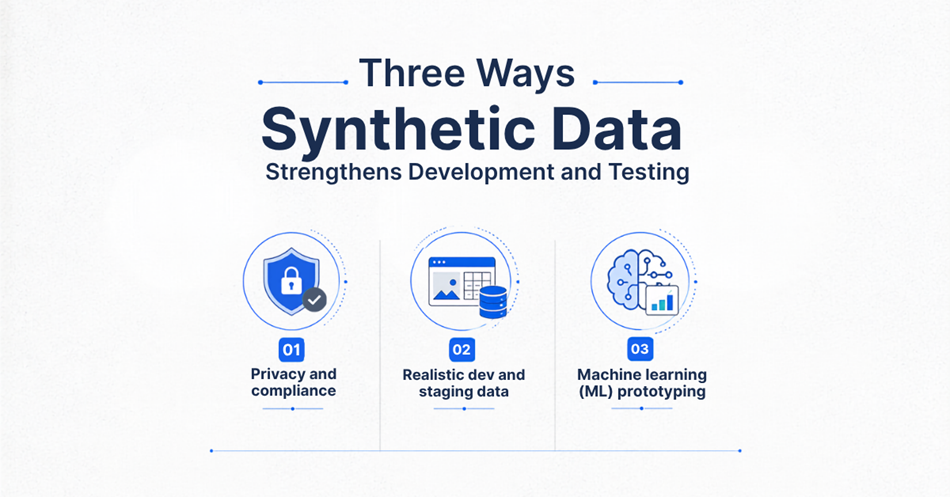
Three workflow areas benefit directly:
- Privacy and compliance. Production environments hold personally identifiable information (PII) and payment details alongside other regulated material that has no place in a staging environment you share with contractors. The moment a developer copies a comma-separated values (CSV) file to a personal machine, your compliance posture weakens.
- Realistic dev and staging data. Your test environments need variety and edge cases at volume, and a handful of seeded rows is not enough. Mimesis generates millions of records that mirror your live data without exposing anything sensitive.
- Machine learning (ML) prototyping. When labeled data is scarce or lives in a regulated silo, synthetic data scaffolds an early version of your pipeline so you can build the model architecture and test the training loop before you see a production sample.
For a deeper look at safe data handling, refer to the article on data anonymization which covers the principles that apply here.
What Makes Mimesis Different From Faker
Faker is the long-standing default for fake data generation in Python, and Mimesis is the modern alternative built around speed and reach. Both libraries solve the same problem, with Mimesis taking a different design approach in three meaningful ways.
First, Mimesis is built for performance. It uses pre-computed datasets and skips regex-based generation, which means it produces large volumes of records much faster than Faker. If you need to seed a database with ten million rows for a load test, this matters.
Second, Mimesis ships with broad locale coverage, and the data within each locale reflects genuine cultural context. Japanese job titles arrive in appropriate katakana for technical roles, and French business titles use the formal corporate terminology common in French workplaces. This depth helps when you build software for international markets.
Third, Mimesis has no hard external dependencies. The library runs on the Python standard library alone, which keeps your virtual environment lean and your dependency tree manageable in containerized deployments.
| Features | Mimesis | Faker |
|---|---|---|
| Performance | Pre-computed datasets, optimized for high volume | Regex-based, slower at scale |
| Locale depth | 34 locales with culturally accurate data | Broad coverage with variable depth |
| Schema-based generation | Built in | Available via add-ons |
| External dependencies | None | Multiple |
| Type hints | Native | Limited |
Getting Started With Mimesis
Installation is one line. Open your terminal and run:
pip install mimesis
From there, you import a provider and start generating data. Here is the simplest possible example:
from mimesis import Person

from mimesis.locales import Locale

person = Person(locale=Locale.EN)

print(person.full_name())     # 'Sarah Patterson'
print(person.email())         # 'patterson_sarah@example.com'
print(person.phone_number())  # '+1-202-555-0143'
The Person provider is locale-dependent, so you specify which language and country you want the data to reflect. Switch the locale to Locale.JA and you get Japanese names and contact details that fit the region.
For real projects, you do not want to import each provider one by one. Mimesis includes Generic provider that gives you access to everything from a single object.
from mimesis import Generic

from mimesis.locales import Locale

gen = Generic(locale=Locale.EN)

print(gen.person.full_name())
print(gen.address.city())
print(gen.datetime.date())
print(gen.internet.url())
That single import covers the common providers you will reach for in a typical data generation script.
Another useful feature is seeding. If you pass a seed value when you create a provider, Mimesis produces the same data each time you run your script.
from mimesis import Person

person = Person(seed=42)

print(person.full_name())  # Same output across runs
That predictability matters for continuous integration (CI) pipelines and reproducible tests, where flaky data can mask genuine failures.
The official Mimesis documentation covers the full provider catalog if you want to explore further.
Mimesis Providers: The Building Blocks
Providers are the core abstraction in Mimesis. Each one focuses on a specific category of data, and you compose them to build the dataset you need. Providers fall into two groups.
Locale-dependent providers return data that reflects a specific language or country. Person and Address fit here. Text also lives in this group, because names and postal codes vary by region, as do idioms, so the output adapts when you switch locales.
Locale-independent providers return data that looks the same regardless of region. Code and Internet fall into this bucket alongside Datetime and Numeric. An international mobile equipment identity (IMEI) number or a universally unique identifier (UUID) does not change based on country, so these providers skip the locale parameter entirely. The Internet provider also generates uniform resource locators (URLs) and internet protocol (IP) addresses, and the Code provider produces International Organization for Standardization (ISO) codes.
| Provider | Type | Generates |
|---|---|---|
| Person | Locale-dependent | Names and contact details |
| Address | Locale-dependent | Streets and postal addresses |
| Text | Locale-dependent | Sentences and paragraphs |
| Internet | Locale-independent | URLs and IP addresses |
| Datetime | Locale-independent | Dates and timestamps |
| Code | Locale-independent | UUIDs and ISO codes |
| Numeric | Locale-independent | Integers and floats |
You can mix locales freely within the same script if your dataset needs to span regions. Mimesis automatically detects which providers depend on locale and which do not, so you do not need to track that yourself.
Building Realistic Datasets With Schemas
Genuine datasets rarely consist of a single field. You need full records with nested values and related attributes that hold consistent format across rows. Mimesis handles this through three classes that work together. Field generates individual values. Fieldset extends that pattern to produce many of the same field type at once, and Schema combines fields into a complete record.
That single block produces five user records ready to drop into a JavaScript Object Notation (JSON) file or load into a test database. Schema supports export to JSON and CSV through built-in methods, so you can pass the output directly to your test fixtures or seed scripts.
Anonymizing Production Data With Mimesis
Anonymization is where Mimesis shifts from convenient to essential. You have a production dataset full of actual customer information, and you need to share it with a data science team or with an external partner. A raw export is not an option. Generic placeholders break downstream tests because the data no longer behaves like production records.
Mimesis offers a middle path. You replace identifying PII with locale-appropriate synthetic values that preserve the original schema and the formatting your downstream systems expect. A name field still contains a plausible name and a phone number parses correctly. Postal codes match the country they claim to belong to.
import pandas as pd

from mimesis import Person

from mimesis.locales import Locale

# Original production data

df = pd.read_csv("customers.csv")
person = Person(locale=Locale.EN, seed=42)

# Replace identifying columns

df["full_name"] = [person.full_name() for _ in range(len(df))]
df["email"] = [person.email() for _ in range(len(df))]
df["phone"] = [person.phone_number() for _ in range(len(df))]

df.to_csv("customers_anon.csv", index=False)
Your downstream pipeline runs against the anonymized file without modification, because the schema and types stay intact. Analytics queries continue to execute and training scripts complete normally. Contractors see realistic data without ever touching a live customer record.
Pair this approach with the broader principles in the article on data masking techniques for a complete view of how to protect sensitive data without sacrificing utility.
For senior data scientists, the ability to build privacy-aware synthetic data workflows has become a defining skill. The Senior Data Scientist (SDS™) certification covers the broader competencies behind this work, with deep focus on the data governance and security architecture decisions that determine whether your anonymization strategy actually holds up under audit.
When to Use Mimesis (And When Not To)
Mimesis works well when your goal is structural realism. You want data that mirrors production records in shape and behavior, with enough volume to fill your test environments at scale.
Reach for Mimesis in these cases:
- Testing pipelines and dev environments. You need realistic-looking data at volume, and you do not care whether the value distributions match production exactly. Mimesis generates millions of rows quickly with no external dependencies.
- Demo and sales environments. Locale-aware records make your demos feel authentic to international prospects, and the data carries zero compliance risk because none of it is real.
- Training data scaffolds. When you need placeholder data to build and validate your model pipeline before real samples arrive, Mimesis fills the gap with realistic records.
- Safe PII replacement. Anonymizing production exports for contractors or external auditors becomes a routine task when Mimesis handles the replacement at scale.
Mimesis works less well when you need statistical fidelity. If your machine learning model depends on exact distributions of values or on cross-feature correlations, you need a different class of tool.
Look at a deep generative library in these cases:
- Training data for production models. When the synthetic data needs to preserve the statistical properties of the original dataset, the Synthetic Data Vault (SDV) and Conditional Tabular Generative Adversarial Network (CTGAN) are built for this.
- Datasets with complex feature relationships. YData Synthetic handles cases where correlations between columns matter as much as the individual values themselves.
- Time-series and sequential data. Generative models capture the temporal dependencies that schema-based generation cannot reproduce.
These libraries learn from your actual data and preserve its statistical properties, at the cost of more setup and compute.
In fact, Mimesis and the deep generative tools solve different problems. Use Mimesis for raw speed and schema accuracy. Reach for SDV or CTGAN when your model depends on the underlying statistics.
Closing Thoughts
Synthetic data has shifted from a testing convenience to a privacy-by-default discipline. As regulators expand their reach and customers grow more aware of how their data moves, the ability to generate realistic, locale-aware records without touching production has become a baseline skill.
Mimesis gives you that capability in your existing Python environment, with no external dependencies and enough speed to handle production-scale workloads. Build it into your workflow now, before the next compliance review forces the question.